

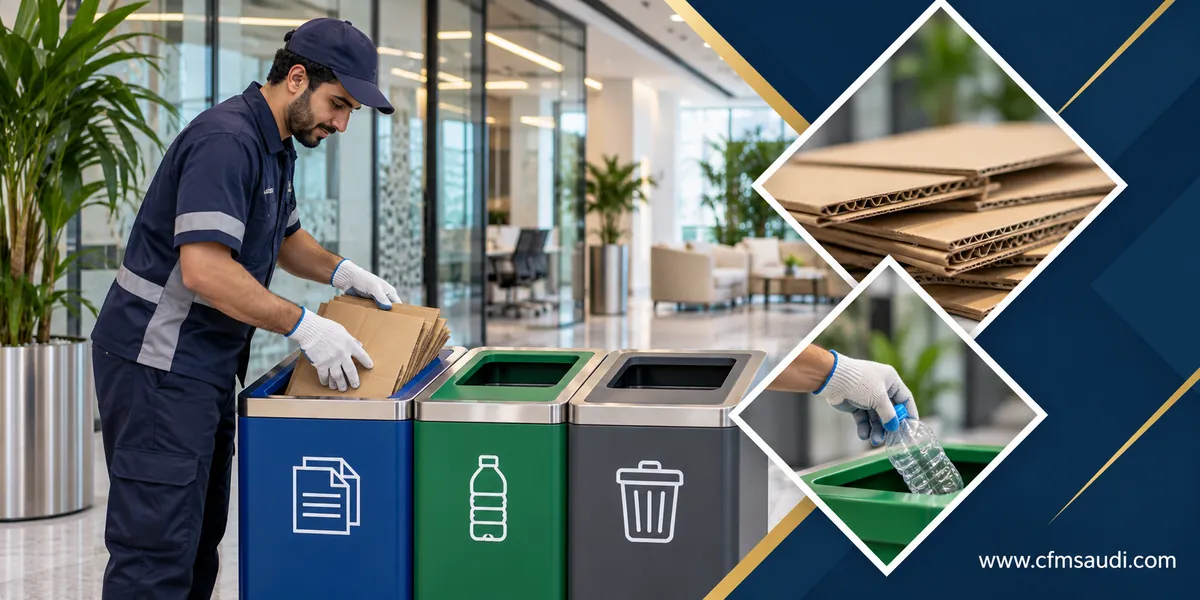
Office waste segregation only works when the separation continues beyond the bin. Different containers in a pantry achieve little if their contents are mixed on the cleaning trolley, in the service room or during collection. The useful starting point is the complete route from the person disposing of an item to the contractor receiving it.
When arranging waste management in Riyadh, ask which materials the collection service accepts and how they need to be presented. Do not assume a recycling symbol means every item is accepted locally.
Confirm the receiving contractor’s requirements
List the proposed streams, such as paper, cardboard, selected packaging and general waste. Confirm accepted items, contamination limits, collection arrangements and any preparation requirements directly with the provider. Keep special wastes outside the ordinary office stream and obtain an appropriate service for them.
Where material needs a separate authorised route, record that route in the site’s procedure. This article is an operational planning guide, not a classification or disposal instruction for hazardous, medical or electronic waste.
Place bins where decisions happen
Look at pantry exits, printer points, meeting areas and delivery locations. Put relevant choices together where practical so users can select the correct container at the point of disposal. A recycling bin far from the activity may be overlooked, even if the office has plenty of containers overall.
Use plain-language labels and simple examples of accepted items. Match those labels to the collector’s requirements. If staff use different languages, agree wording and pictograms that the actual occupants understand; colour alone is not a reliable instruction.
Design the cleaning route
Discuss segregation during office cleaning mobilisation, not only with office employees. Cleaners need to know which bags or containers belong to each stream, where they go and what to do when contents are mixed.
- Identify the collection points on the cleaning route.
- Agree containers or compartments that preserve separation.
- Label storage positions in the service area.
- Define who reports contamination and overflowing bins.
- Confirm who hands material over to the collection contractor.
Do not expect cleaning staff to sort unknown or potentially hazardous contents by hand. The site procedure should give them an appropriate escalation route.
Check the storage and collection handover
Visit the final storage area as well as the public-facing bins. Check whether labels remain clear, collections fit available capacity and unrelated deliveries obstruct access. Agree how missed collections and unusual volumes are reported before the area becomes unmanageable.
Keep collection records where supplied. If you report recycling results, distinguish measured weights from estimates and material collected from material demonstrably recycled. Those are different claims, and records should support the wording used.
Improve one problem at a time
For an initial review, choose a few representative points and record recurring errors. A pantry bin containing food-soiled packaging may need clearer examples or a different arrangement. A storage-room issue may require a contractor handover change rather than another staff email.
Recheck after the change and document the outcome. Avoid introducing more streams than the office and receiving service can consistently manage.
Prepare the brief
Share your occupancy, existing bin layout, waste types and collection constraints with Crystal Facilities Management. Coordinating cleaning and collection responsibilities gives the office a clearer process from disposal to handover, with fewer assumptions between teams.